Sugar-free chocolate cake
Sugar does more than sweeten: it holds water, tenderises the crumb and browns the crust. What you lose by removing it, and how to fix each fault.
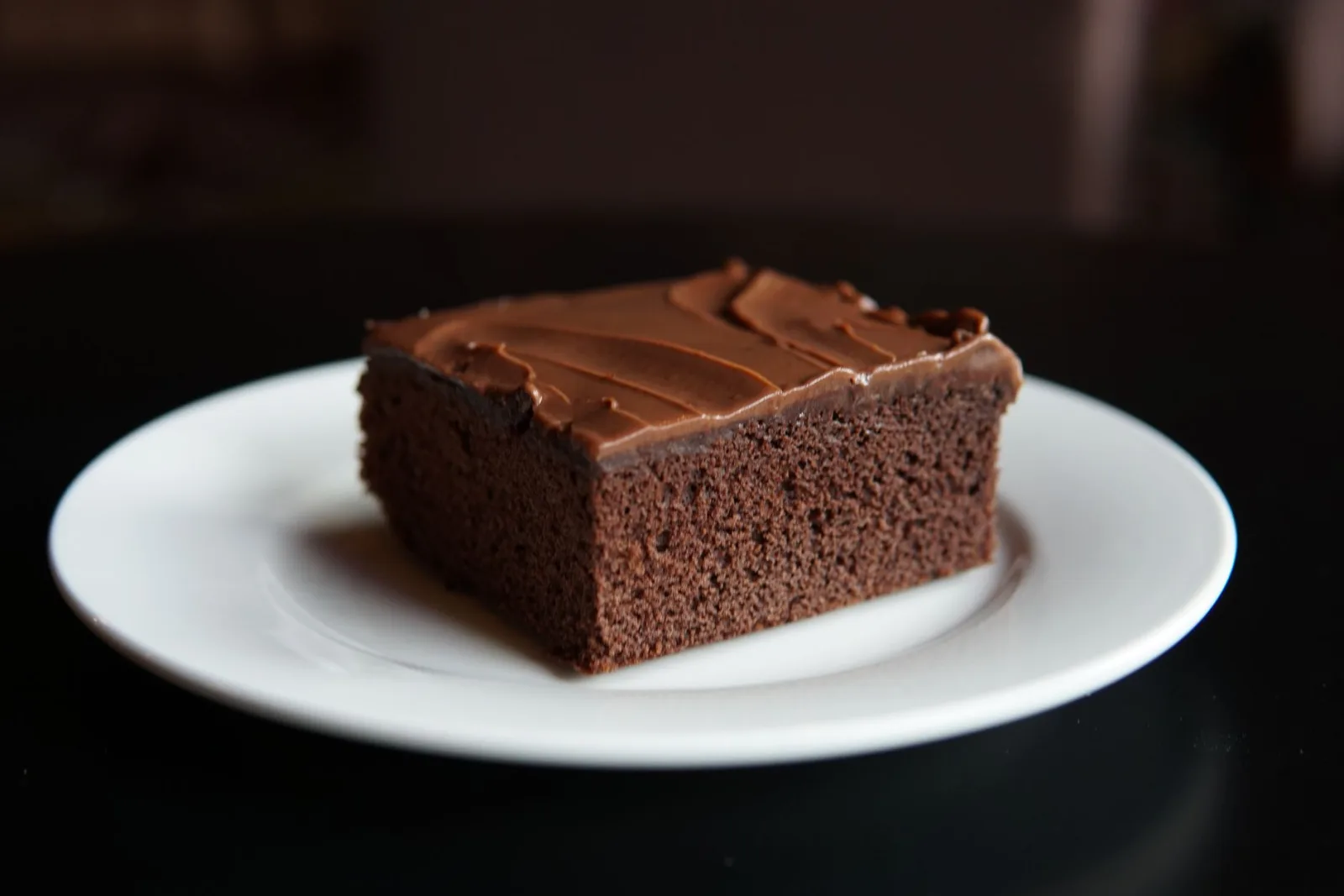
A sugar-free chocolate cake nearly always fails for the same reason: sugar is treated as a flavour ingredient, when it actually plays four roles in a batter, and three of them have nothing to do with sweetness.
It took me three failed attempts to work that out. The first was a dry, pale disc, the second had a cold aftertaste, and the third collapsed in the middle.
The four jobs sugar does in a batter
- It holds water. Sugar is hygroscopic: it captures moisture and keeps it. That is what makes a cake still soft the next day.
- It tenderises. It interferes with gluten formation and delays egg coagulation. Without it the crumb tightens and turns rubbery.
- It browns. A brown crust comes from caramelisation and the Maillard reaction, neither of which happens without sugar.
- It traps air. When butter is creamed with sugar, it is the edges of the crystals that carve out the bubbles. An ultrafine powder does not do this.
Removing sugar therefore means accepting, by default, a cake that is drier, firmer, paler and stale within a day. The whole job is to restore those four functions one at a time.
The chocolate trap, to settle first
This is the mistake that invalidates the recipe before you even start: dark chocolate at 70 % contains roughly 30 % sugar. In a cake using 200 g, that is 60 g of sugar nobody counted.
For a genuinely sugar-free cake you need 100 % chocolate (pure cocoa mass) or a no-added-sugar chocolate, and you have to accept that bitterness rises a notch. I blend 150 g of 100 % chocolate with 50 g of unsweetened cocoa powder, which softens the texture without adding sweetness.
Same logic as with icing without icing sugar: until the hidden sugar has been inventoried, you are correcting blind.
The substitutes, and what each one costs
| Substitute | Sweetening power | What it does well | Its fault |
|---|---|---|---|
| Erythritol | about 70 % of sugar | no bitterness, heat stable | recrystallises on cooling, cold mouthfeel |
| Xylitol | equal to sugar | hygroscopic, keeps the crumb soft | toxic to dogs, even in crumbs |
| Date purée | close to sugar | brings water and binding | it is not sugar-free, it is fruit sugar |
| Stevia, sucralose | 200 to 600 times | tiny dose needed | leaves no mass in the batter |
A half-and-half blend of erythritol and xylitol gave me the best result. Erythritol alone leaves that characteristic cold tingle, xylitol alone makes the batter sticky. Together, the two faults largely cancel out.
The volume question, the one people forget
150 g of sugar is 150 g of matter in the recipe. Replacing it with 1 g of stevia leaves a 149 g hole, and that is exactly why the third attempt collapsed.
Two ways to fill that hole:
- Ground almonds, 60 to 80 g. They bring fat, therefore softness, and a close but tender crumb.
- Fromage blanc or Greek yoghurt, 100 g, which return the water sugar no longer holds.
I use both together. That is what brings the texture closest to a classic moist chocolate cake.
The ratios I settled on
For a 20 cm tin:
- 150 g of 100 % chocolate and 50 g unsweetened cocoa
- 120 g butter
- 4 eggs
- 100 g erythritol and 50 g xylitol
- 70 g ground almonds
- 100 g fromage blanc
- only 40 g flour
- 1 teaspoon baking powder
- a pinch of salt, and it matters: salt lifts the cocoa once sugar no longer does
Beat the whole eggs with the sweeteners for a good five minutes, until the mixture pales and doubles. That aeration replaces the air sugar crystals no longer carve out.
Then fold in the chocolate melted with the butter, warm but not hot, followed by the ground almonds and fromage blanc, and finally the flour sifted with the baking powder and salt. Use a spatula and lift the batter: it is the air in the eggs that will raise this cake, not the baking powder.
Baking, lower and shorter
Without sugar there is no caramelisation to mark the surface, and the cake can dry out before it looks done. It is the opposite trap to the brownie without butter.
160 °C, 25 minutes, no more. The centre should still wobble slightly. In my oven, which runs hot underneath, I put the tin on the upper shelf with an empty tray below.
And one rule that is not negotiable: this cake is eaten the same day or the next. With no sugar to hold water, it dries quickly, even under a dome.
Frequently asked questions
Can a chocolate cake be made with no sugar at all, not even a sweetener? Technically yes, but the result is a bitter cake few people finish. Pure cocoa is intensely bitter, and with no sweetening agent nothing balances it. Date purée is the most honest compromise for anyone refusing sweeteners, bearing in mind that it does bring sugar.
Why does my sugar-free cake taste cold in the mouth? That is the erythritol. Dissolving absorbs heat, producing a cooling sensation close to mint. Cutting it with xylitol or allulose clearly reduces the effect.
Can erythritol replace sugar weight for weight? No, its sweetening power is around 70 % of sugar’s. For the equivalent of 100 g of sugar you need about 130 g. But raising the dose increases recrystallisation on cooling, which is why the blend is worth it.
Does the cake freeze? Yes, and it is the best solution given how fast it dries. I cut it into portions and freeze them individually, taking one out 30 minutes ahead. Freezing also masks the erythritol recrystallisation well.