Pink praline tart, the Lyon classic
A good praline tart needs just two ingredients, pink pralines and cream, but everything rides on the reduction. Too short and it runs; too long and it breaks your teeth. The signs to aim for.
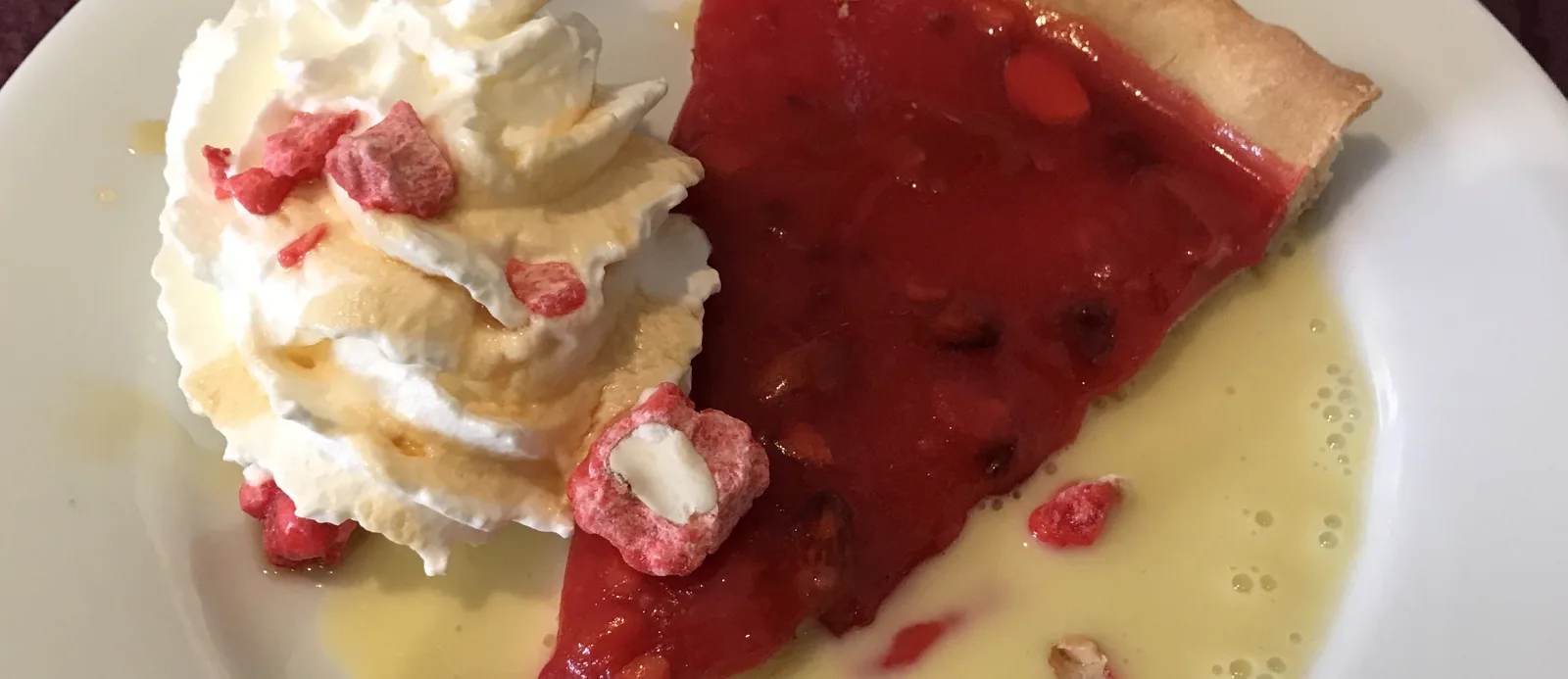
The pink praline tart is the simplest tart I know: a pastry case, pink pralines, cream. And yet it is one of the most temperamental. Depending on the day, the filling runs across the plate as soon as the first slice is cut, or it sets like toffee and sticks to your teeth. It all comes down to one step, reducing the cream, which recipes often sum up as “cook for a few minutes”.
It is not a tart from my part of the world, Alsace: it is a Lyon speciality, which I discovered at friends’ and ruined three times before I understood how it works.
What a pink praline is
In Lyon, a praline is neither a Belgian chocolate nor praline paste. It is an almond, sometimes a hazelnut, coated in cooked sugar coloured pink, layer after layer, until it forms an uneven, crunchy shell.
In the tart, that sugar shell melts into the hot cream and forms a syrupy, bright pink filling, while the almonds stay whole and add crunch. The recipe is generally credited to the Lyon chef Alain Chapel, who is said to have popularised it in the 1970s, before it became a staple of bakeries across the region.
Pink pralines are sold in bags in the baking aisle of French supermarkets, or ready crushed. Crushed pralines save time but melt a little less evenly than whole pralines you crush yourself.
The ratios
For a 24 cm tart tin:
- 1 sweet shortcrust pastry, about 250 g
- 250 g pink pralines
- 250 ml whole liquid cream, at least 30 % fat
That is all. The ratio of one gram of pralines to one millilitre of cream is the most reliable starting point. Light cream will not set: it lacks the fat that gives the filling its hold once cold.
The case, fully blind baked
The filling does not go in the oven: it is poured hot into the already baked case. The pastry must therefore be baked through and well browned, or it stays doughy under the cream.
- Line the tin and prick the base with a fork.
- Chill for 30 minutes, pastry already in the tin. That rest is what stops it shrinking, as I explain in the article on why shortcrust shrinks.
- Blind bake at 170 °C, with baking paper and beans, for 15 minutes.
- Remove the beans and bake for another 10 to 12 minutes, until evenly golden.
The case must be completely cool before the filling goes in. To seal the pastry, the same trick as for the strawberry mascarpone tart works: egg white brushed on, two minutes in the oven at the end of baking.
The reduction, the only real skill
- Crush the pralines with a rolling pin, in a freezer bag. Keep pieces somewhere between half a grain of rice and a lentil. Too fine and they turn to powder, and the filling loses its crunch.
- Put the pralines and cream in a saucepan over medium heat and bring to a simmer, stirring.
- Let it reduce at a gentle simmer for 8 to 12 minutes, stirring often with a spatula, until the sugar has melted and the mixture has clearly thickened.
The sign that never lies: the filling coats the spatula, and a line drawn through it with a finger stays clean. By then it has lost about a third of its volume and has the consistency of hot jam.
A filling that still looks too runny while hot is often just right: it thickens a lot as it cools. That is the classic trap, the one that gave me a concrete tart the second time. Better to stop a little early than too late.
Assembling, and resting
Pour the hot filling into the cooled case straight away and spread it with a spatula. It levels itself almost on its own.
Then leave it to set for at least two hours at room temperature, or one hour in the fridge. Cut too early, even a well-reduced filling runs.
A praline tart is served at room temperature, often with lightly sweetened whipped cream to soften its sweetness. A mascarpone whipped cream holds up better on the plate than plain whipped cream.
What goes wrong, and why
| Symptom | Cause | Fix |
|---|---|---|
| Filling runs when cut | reduction too short, or cut too soon | reduce until it coats, wait two hours |
| Hard, sticky filling | reduction too long | stop as soon as the spatula is coated |
| Doughy base | pastry not blind baked enough | bake until evenly golden |
| Grainy filling | pralines not fully melted | stir throughout the reduction |
| No crunch | pralines crushed to powder | crush coarsely |
| Filling will not set | light cream | whole cream, 30 % fat minimum |
Frequently asked questions
How long does a praline tart keep? Two to three days, under a cover, in a cool place. In the fridge the pastry softens and the filling turns very hard: take it out an hour before serving.
Can a runny filling be rescued once poured? Not once it is in the tart. But before pouring, it can always go back on the heat for two or three minutes. And a filling that is too stiff loosens with a little hot cream added to the pan.
Can shortcrust replace sweet pastry? Yes. Plain shortcrust, being less sweet, even balances the very sweet filling better. Sweet pastry remains the most common choice in Lyon bakeries.
Can a praline tart be made without pink pralines? Not really: it is the cooked sugar of their coating that makes the filling. Homemade caramelised almonds give a good tart, but a different one, and without the colour.