Mascarpone whipped cream: the method
Mascarpone alone does not whip, it curdles. The right ratio with double cream, the order of the steps, and how to rescue a split cream.
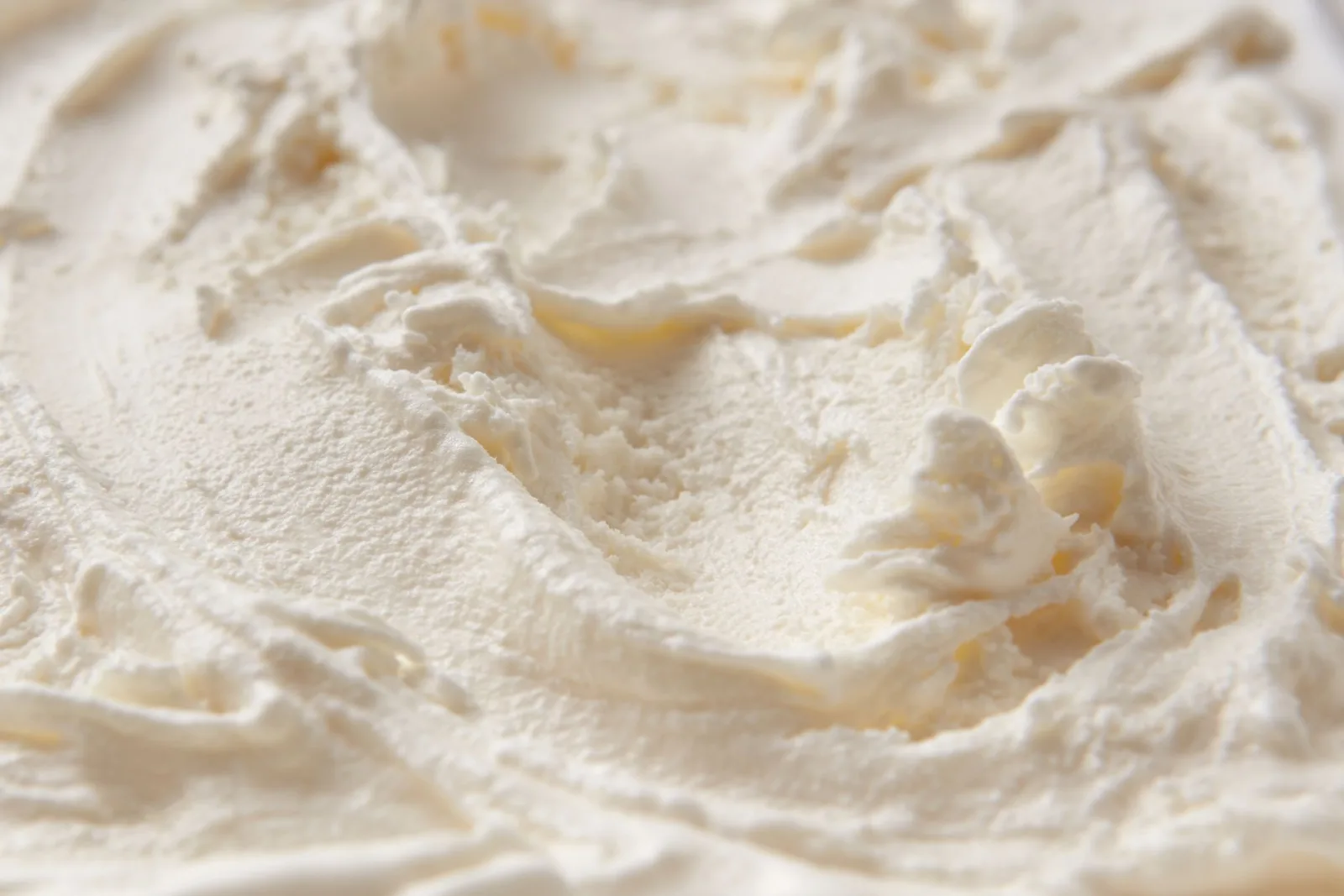
Whipping mascarpone into a whipped cream is a misleading way to put it, and it causes most of the failures: mascarpone alone does not whip. It thickens, then it curdles, then it splits. What people call mascarpone whipped cream is in fact a blended whipped cream, and everything comes down to the ratio.
I wasted three tubs of mascarpone before realising I was not getting the technique wrong, I was getting the recipe wrong.
Why mascarpone alone curdles
Whipped cream holds because the fat globules in liquid cream clump around the air bubbles you whisk in. So you need globules that are free in a liquid.
Mascarpone is not a liquid: it is an already coagulated cream, around 40 % fat, whose structure is set. Whisking it does not create foam, it breaks the existing emulsion: the water separates and you get those shiny lumps.
Same logic as whipped chocolate ganache: the fat must be organised before it is aerated, never during.
The ratio, the only thing that really matters
| Mascarpone to cream ratio | Resulting texture | Best used for |
|---|---|---|
| 1 to 3 | light, close to a classic whipped cream | quick topping, fruit cups |
| 1 to 2 | firm and supple, pipes well | the reference ratio, good everywhere |
| 1 to 1 | dense, almost buttery | layer cakes, maximum hold in summer |
| Mascarpone alone | curdles every time | nothing |
The reference ratio, the one I use nine times out of ten: 125 g of mascarpone to 250 g of double cream, roughly one small tub and one carton.
The cream must be full fat, at least 30 %. A 15 % cream will not whip, whatever the mascarpone.
The order of the steps, which is counter-intuitive
This is where nearly everyone goes wrong, myself included for two years.
- Everything must be cold: bowl, whisk, cream, mascarpone. I put the bowl in the freezer ten minutes beforehand. Do not bring the mascarpone to room temperature, contrary to what many recipes say.
- Loosen the mascarpone first, with a spatula, using only two tablespoons of the cream. You want a smooth paste with no lumps. No electric whisk at this stage.
- Pour the rest of the cold cream onto that smooth base, and only then start whisking.
- Medium speed, not maximum. A cream whipped slowly is more stable and forgives a few extra seconds.
- Icing sugar halfway, once the cream starts to thicken. Caster sugar does not fully dissolve and leaves a gritty cream.
Allow two to three minutes. Stop at soft peaks: the cream falls back in a soft point on the lifted whisk. Beyond that it turns grainy, then to butter.
Rescuing a split cream
As long as it has not turned properly buttery, it is usually recoverable.
Stop the mixer immediately. Add one or two tablespoons of very cold cream and fold it in by hand, with a whisk, without whipping: just stir. The cold cream rebuilds the emulsion and smooths the lumps.
If the fat has genuinely separated, the whipped cream is gone, but the mixture is not wasted: it goes into a no-bake chocolate cake, where texture no longer matters.
What this cream holds, and for how long
This is the real point of mascarpone, and the reason to prefer it to a plain whipped cream:
- It does not weep. A classic whipped cream releases liquid after a few hours, this one does not.
- It holds for 48 hours in the fridge, covered with cling film touching the surface, without collapsing.
- It pipes well without melting under the warmth of your hand.
- It needs no stabiliser, no gelatine, no commercial fixative.
That also makes it comfortable on a tart that has to wait, unlike a classic pastry cream such as the one in a French custard tart, which does not whip at all.
Frequently asked questions
Can mascarpone be whipped on its own? No. Mascarpone is an already coagulated cream with no free fat globules to aerate. Whisking it alone breaks its emulsion and produces lumps, then a water-fat separation. It has to be combined with full-fat liquid cream.
What is the right mascarpone to cream ratio? One part mascarpone to two parts full-fat cream, so 125 g to 250 g, suits almost every use. One to three gives a lighter cream, one to one a dense cream that holds heat better but turns buttery quickly under the whisk.
Why is my mascarpone whipped cream grainy? Either the mascarpone was whisked before being loosened with a little cream, or the whole thing was whipped too long or too fast. In both cases, adding a spoonful of very cold cream and stirring by hand with a whisk usually rescues the texture.
How long does mascarpone whipped cream keep? Two days in the fridge, in a container with cling film touching the surface. It does not weep like a classic whipped cream, which makes it the most reliable cream for a cake prepared the day before.
Icing sugar or caster sugar? Icing sugar, added once the cream starts to thicken. Caster sugar does not have time to dissolve in a cold preparation and leaves a gritty feel.