Easy madeleines with a proper hump
An easy madeleine recipe takes five ingredients in equal weights. The hump comes from a thermal shock that most recipes never bother to explain.
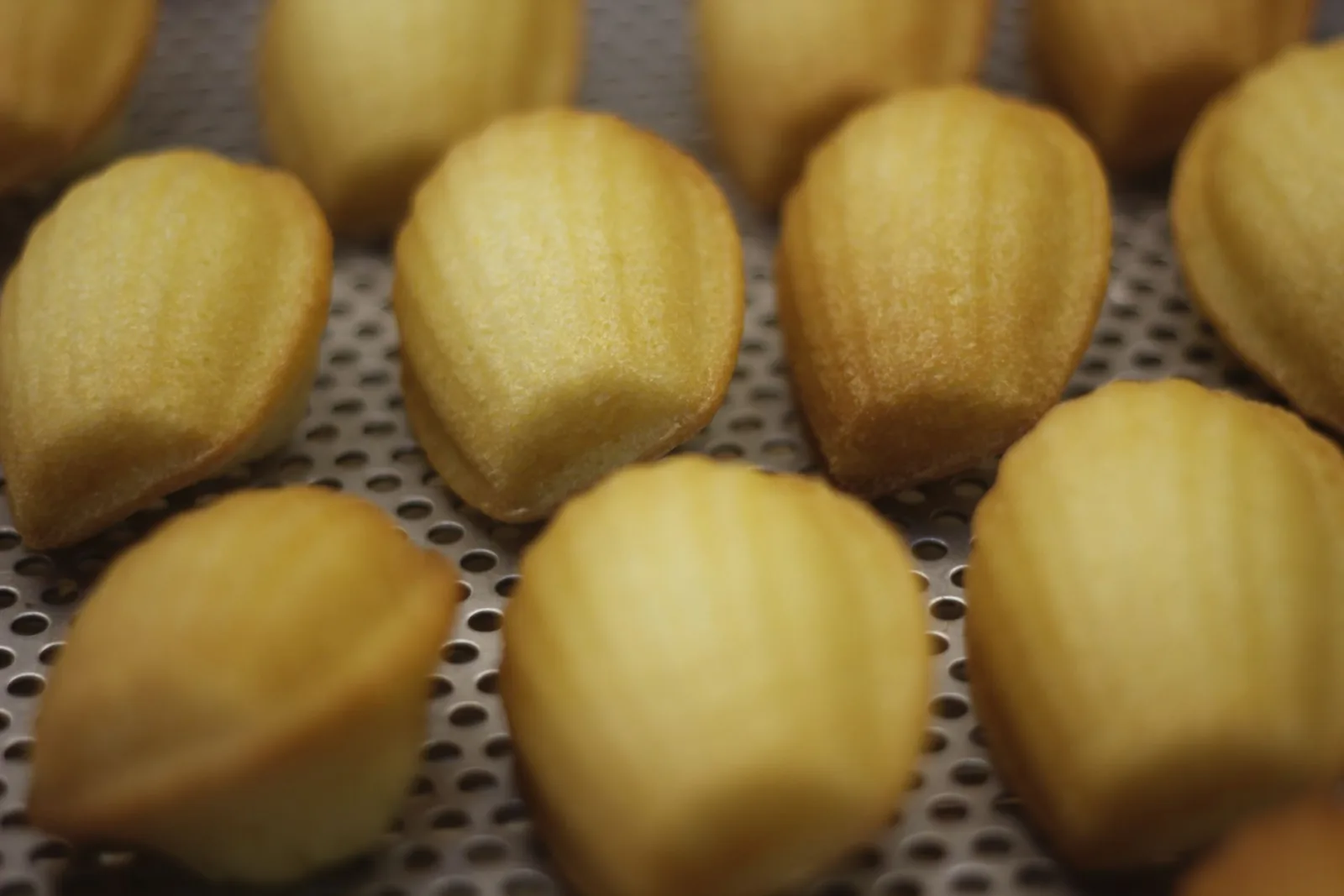
An easy madeleine recipe takes five ingredients weighed in equal amounts: eggs, sugar, flour, butter, plus a little baking powder. It is the simplest batter of the afternoon treat repertoire. What is not simple is the hump, and it hardly depends on the recipe at all: it comes from a very cold batter going into a very hot oven.
My first batches came out flat, golden at the sides and burnt underneath. The batter was fine. The way I was baking it was not.
The recipe, in equal weights
For 18 to 20 madeleines in a standard tin:
| Ingredient | Quantity | What it does |
|---|---|---|
| Eggs | 2 (about 100 g without shells) | structure and moisture |
| Sugar | 100 g | tenderness and colour |
| Flour | 100 g | body |
| Butter | 100 g, melted | flavour and softness |
| Baking powder | 4 g, one level teaspoon | the push behind the hump |
| Honey | 15 g, one tablespoon | keeps them soft for days |
| Lemon zest, salt | 1 lemon, 1 pinch | flavour |
It is pound cake logic on a small scale. Weighing the eggs and setting everything else to their weight is what makes the recipe repeatable, because a “large egg” varies from 50 to 65 g.
The honey is not decoration. Like sugar, it holds water, and does it even better: that is the difference between a madeleine still tender two days later and one that crumbles. I covered this role of sugar in the article on sugar-free chocolate cake, which shows what happens when it is missing.
The method in five steps
- Melt the butter and let it cool to lukewarm. If it is still hot when it meets the eggs, it cooks them in places.
- Whisk the eggs with the sugar and honey for a minute, without trying to make them foam. An over-aerated batter rises everywhere and never forms a clean hump.
- Add the flour sifted with the baking powder and salt, mixing just until there are no lumps.
- Pour in the lukewarm butter and the zest, and mix until the batter is smooth and glossy.
- Cover with cling film touching the surface and chill for at least 3 hours, ideally overnight.
That last step is the one “quick” recipes drop, and it is the one that makes the hump. Same principle as resting the dough for American cookies: without it the recipe is right, but the result is not.
The hump: what really makes it
In a hot tin, the edges of the madeleine bake first and set. The centre, thicker and still cold, stays liquid for longer. When the baking powder and steam start pushing, the batter can no longer spread sideways: it rises through the middle, and that is the hump.
So you need a sharp temperature gap between batter and tin, and a batter firm enough not to spread before it sets.
| Symptom | Most common cause | Fix |
|---|---|---|
| No hump at all | batter not rested long enough, or at room temperature | overnight in the fridge, taken out at the last moment |
| Hump that collapses | too much baking powder, or oven opened too early | 4 g per 100 g of flour, door closed for 5 minutes |
| Madeleines overflowing | tin overfilled | fill three quarters, without spreading |
| Burnt bottom, pale top | too much heat from below | rack in the middle, empty tray underneath |
Do not spread the batter in the moulds. One heaped spoonful in the centre, and the heat does the rest.
The tin, metal or silicone
A metal tin gives the best humps. It conducts heat fast, the edges set immediately and the ridges of the shell brown nicely. Silicone heats slowly: madeleines rise more evenly in it, with a timid hump and a pale shell.
A metal tin is buttered with a brush, then floured, tapping out the excess. I put it in the freezer for ten minutes once buttered: the butter sets, the batter does not stick, and the temperature gap is even sharper.
Baking, in two stages
Oven preheated to 220 °C for 5 minutes, then 180 °C for 5 to 6 minutes. The first stage sets the edges and starts the hump, the second cooks the centre without burning the shell.
My oven runs too hot underneath, which is the worst case for a madeleine tin sitting directly on the floor of the oven: the bottom browns before the hump has risen. I put the tin on a rack halfway up, with an empty tray on the shelf below as a shield. It is the same trick as for a moist chocolate cake, and it works for nearly everything that bakes fast.
Unmould immediately and cool on a rack. Left in the tin, madeleines condense their steam against the metal and the underside goes soft.
Storage
A madeleine is at its best warm, within the hour. After that:
- Three days in an airtight tin, at room temperature. This is where the honey makes all the difference.
- One month in the freezer, in a sealed bag. Ten minutes in the open air brings them back to softness.
- Never in the fridge, where they dry out overnight.
The raw batter keeps for 48 hours covered in the fridge. That is what I do on weekdays: batter in the evening, and two batches after school, filling the tin while the oven heats.
Frequently asked questions
Why don’t my madeleines have a hump? Almost always because the batter was not cold enough or the oven not hot enough. The hump comes from the gap between the two: a batter rested overnight in the fridge and baked at 220 °C to start with forms one almost every time.
Can madeleine batter be made the day before? Yes, and it is actually recommended. It keeps for up to 48 hours in the fridge, covered with film touching the surface. Beyond that the baking powder loses strength and the madeleines rise less.
Can I use a silicone tin? Yes, but the hump will be smaller and the shell paler, because silicone conducts heat poorly. Setting it on a preheated metal tray helps a little.
Why do my madeleines stick to the tin? The tin was not buttered well enough into the ridges, or the madeleines were left in it after baking. Butter with a brush, flour, and unmould straight out of the oven.