Cookie mug cake, soft in the microwave
A cookie mug cake nearly always fails the same way: it comes out spongy or rubbery. The yolk-only trick, the right quantities and the cooking time that keep it soft and gooey.
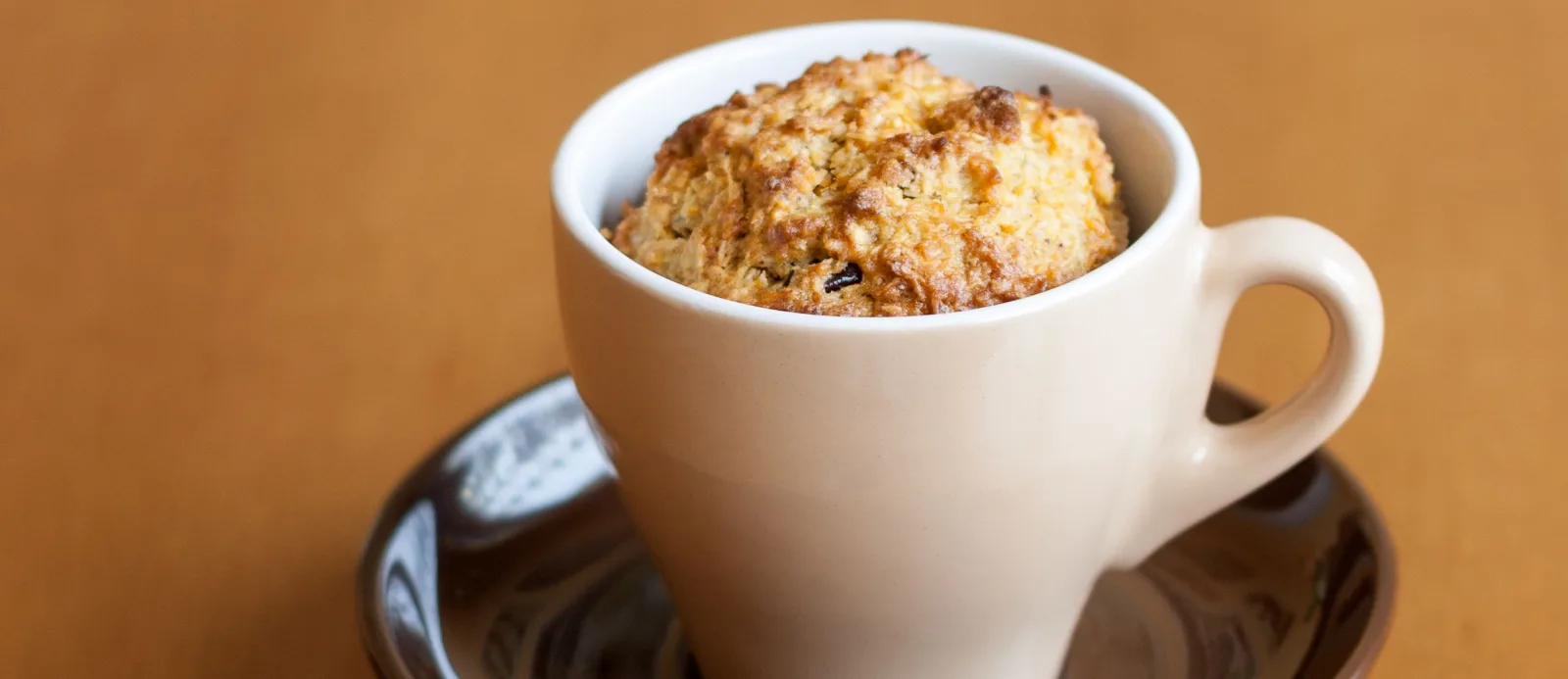
A cookie mug cake should taste like a warm cookie with a centre that is still gooey. Most of the time it comes out of the microwave like a small sweet sponge, or worse, like a rubber ball that hardens as it cools. The microwave is almost never to blame: the fault lies with the whole egg, found in most recipes, and with twenty seconds too many of cooking.
At home, it is the treat for the Wednesdays when nothing is ready. It took me a good fifteen mugs to stop getting a cake when what I wanted was a cookie.
A cookie, not a cake in a mug
A classic mug cake is a cake: plenty of egg, baking powder, an airy crumb. A cookie is the opposite: butter, sugar, very little liquid, and a dense texture that stays soft in the middle. The American cookie owes its soft centre precisely to that low moisture and to brown sugar.
Translated to the microwave, that gives three rules:
- no whole egg, only the yolk. The white sets in a few seconds and creates the springy texture mug cakes are blamed for;
- no baking powder, or a knife-tip at most. It puffs the batter up, which then collapses and tightens;
- a mix of white and brown sugar, for the caramel flavour and the softness.
Quantities, for one mug
For a 250 to 300 ml mug, preferably wide rather than tall:
- 15 g butter, melted in the mug itself
- 1 level tablespoon brown sugar (about 12 g)
- 1 teaspoon white sugar (about 5 g)
- 1 egg yolk
- a few drops of vanilla
- 30 g flour, or 3 level tablespoons
- 1 pinch of salt
- 20 g chocolate chips, or chopped chocolate
Without brown sugar to hand, white sugar alone works, with a slightly less chewy result: that is exactly what the article on cookies without brown sugar covers.
The method, in two minutes
- Melt the butter in the mug, 15 to 20 seconds at 800 W. It should be liquid, not boiling.
- Add both sugars and stir with a fork, then the vanilla and the yolk. Stir until smooth and glossy.
- Add the flour and salt, and stir just enough that no dry flour remains, scraping the bottom of the mug well.
- Fold in the chips, keeping a few back for the top.
- Press the batter down lightly and smooth the surface.
The batter should look like cookie dough, thick, not like cake batter that runs. If it runs, the egg was a large one: add a teaspoon of flour.
Cooking, to the second
40 to 50 seconds at 800 W, no more. At 1,000 W, allow 30 to 40 seconds. At 600 W, 60 to 70 seconds.
The right sign is not a surface that looks dry all over. The edges should be set and the centre still slightly glossy. It finishes cooking during a minute’s rest, from the heat of the mug. Wait until it looks done in the middle and it will be dry once lukewarm.
A microwave heats through the water in the batter, from the inside, and never browns anything. That is why this mug cake stays pale, and why a few seconds too many are enough to dry it out. I go into this at more length in the comparison of cake without an oven methods, where the microwave has very precise limits.
A narrow, tall mug gives a raw centre and dry edges: the batter is too deep to cook evenly. A wide mug, with 2 to 3 cm of batter, cooks far more evenly.
What goes wrong, and why
| Symptom | Cause | Fix |
|---|---|---|
| Spongy texture, like a cake | whole egg, or baking powder | yolk only, no baking powder |
| Rubbery, hardens as it cools | cooked too long | take it out while the centre still shines |
| Raw centre, dry edges | mug too tall and narrow | wide mug, 2 to 3 cm of batter |
| Greasy at the bottom of the mug | butter too hot, poorly mixed | lukewarm butter, stir the sugar in first |
| All the chips at the bottom | batter too runny | one extra teaspoon of flour |
Variations that work
- Egg-free: replace the yolk with 1 tablespoon of milk. The texture is more crumbly, closer to a tender shortbread.
- Molten centre: push a square of chocolate into the middle of the batter before cooking.
- Double chocolate: replace 5 g of flour with 5 g of unsweetened cocoa, a little in the spirit of the brownie without butter, where cocoa carries most of the flavour.
- Peanut butter: replace half the butter with peanut butter, and reduce the salt.
Frequently asked questions
Can the batter be made ahead? Yes, up to the day before, covered in the fridge right in the mug. Add 10 seconds of cooking, since the batter is cold.
Why does my cookie mug cake overflow? There is baking powder in the recipe, or a whole egg that puffs up in the heat. With the yolk alone and no baking powder, the batter barely rises.
Can it be baked in a regular oven? Yes, in an oven-safe ramekin, 10 to 12 minutes at 180 °C. You then get a real little spoon cookie, golden on top.
Can it be eaten cold? It is best lukewarm, a few minutes out of the microwave. Once cold, even when well cooked, it firms up noticeably.