Brownies without butter: what you lose
Butter gives a brownie its fudginess and its crackled top. The three substitutes that genuinely work, what each one removes, and the ratios you have to correct.
Taking butter out of a brownie is not taking out fat: it is taking out three things at once, and only the first is obvious.
What butter does in a brownie
It provides fat, which coats the flour and stops gluten developing. That is what gives the dense, fudgy texture, the opposite of an airy cake.
It provides water, about 16 % of its weight. That water evaporates during baking and helps lift the surface.
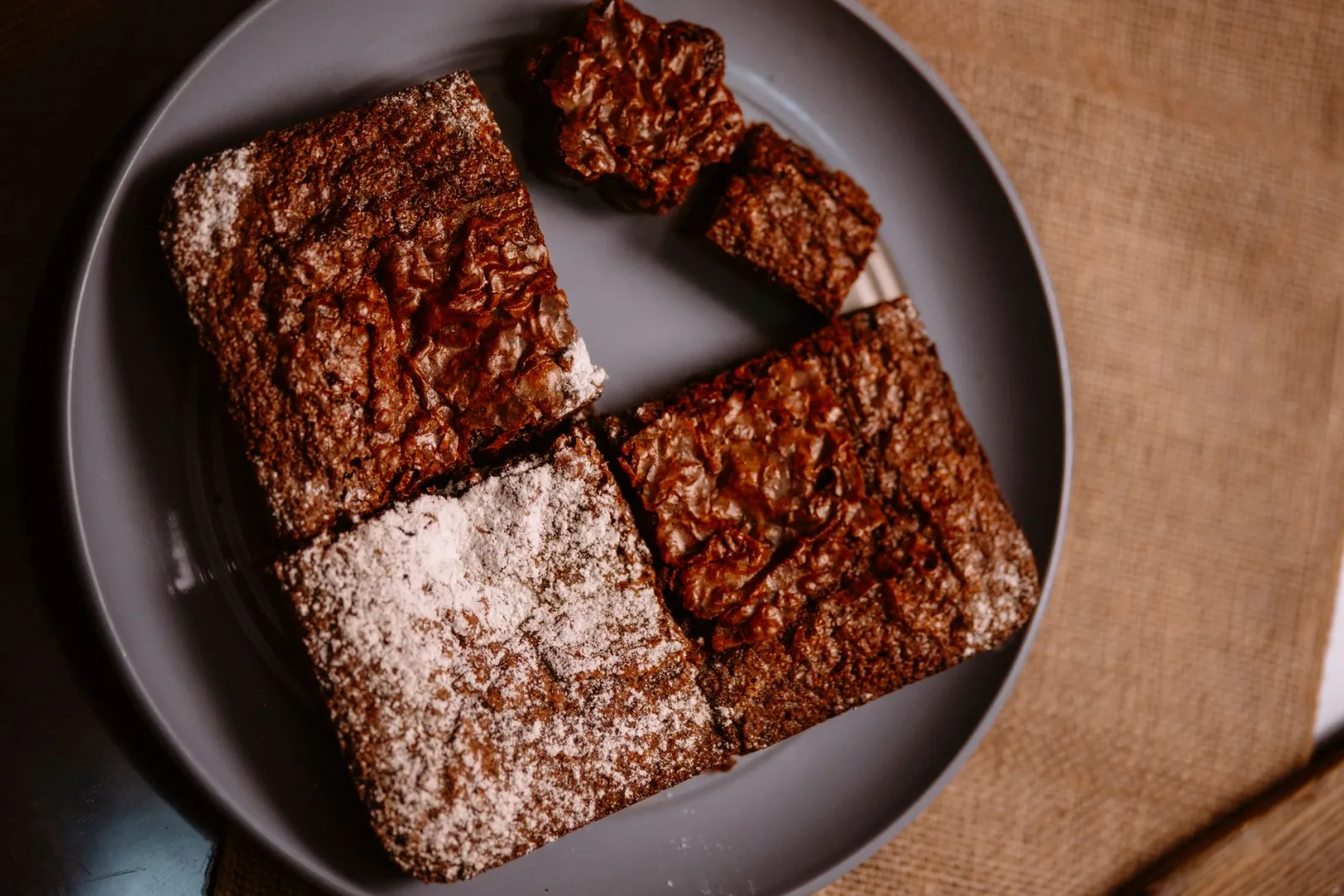
And it provides milk proteins, responsible for the flavour and above all for the thin crackled top, the thing that separates a good brownie from a good chocolate cake.
A substitute that only replaces the first of the three gives a decent but flat brownie, with no crust and no depth. That is the most common outcome.
The three substitutes that work
| Substitute | Amount per 100 g butter | What you get | What you lose |
|---|---|---|---|
| Neutral oil | 80 g | The fudgiest of the three, holds well | The crackled top, and some flavour |
| Nut butter | 110 g | Lots of flavour, tight texture | Softness, it turns compact |
| Apple sauce | 100 g | A light, almost damp brownie | The fudginess, and it dries in 48 h |
Oil is the best default. Use 20 % less than the butter, because oil is 100 % fat against 82 % for butter. Matching the weight gives an oily brownie that leaves a mark on the plate.
Almond or peanut butter works very well, but it brings its own flavour and dry matter. Add 20 ml of milk to compensate.
Apple sauce changes the result most. I keep it for brownies eaten the same day: by the next morning they are dry.
Getting the crackled top back
This is the part most butter-free recipes give up on, although it can be recovered.
The crust comes from dissolved sugar rising to the surface and crystallising. It depends far less on butter than on how you treat the eggs and sugar.
The move that brings it back: whisk the eggs and sugar for a good three minutes, until the mixture pales and nearly doubles, before folding in the melted chocolate. It is that foam which bakes into the thin glossy film.
Two further conditions: the melted chocolate must be warm, not hot, or it collapses the foam; and the batter must not wait, it goes straight into the oven.
The corrected ratios
For a 20 x 20 cm tin, my reference base:
- 200 g dark chocolate, 55 %
- 80 g neutral oil (instead of 100 g butter)
- 150 g sugar
- 3 eggs
- 60 g flour
- a pinch of salt
The salt is not a detail. Salted butter brings roughly 0.8 g of salt per 100 g; without it, an oil-based brownie tastes flat. A good pinch puts it right.
Baking changes too
Without butter the batter heats slightly faster. I drop from 180 to 170 °C, for 22 to 25 minutes.
The cue is the same as for a classic brownie and it is counter-intuitive: the centre should still wobble when you take the tin out. A brownie baked through in the oven will be dry once cool. As with gluten-free cookies, the window is narrow and it is better to be early than late.
In my oven, which runs far too hot underneath, I put the tin on the upper shelf with an empty tray below. Without it, the base sets hard long before the centre.
Frequently asked questions
Can margarine replace butter? Yes, at the same weight, and it is the most faithful substitute for texture since it also contains water. It brings no milk proteins, so the crust stays fainter.
Does olive oil work? A mild olive oil, yes, and it pairs well with 70 % chocolate. A fruity or peppery oil dominates the chocolate, which is not necessarily a fault but makes a different cake.
Why is my butter-free brownie crumbly? Too much flour, or not enough fat after the conversion. Check you used 80 g of oil by weight and not 80 % of the volume, which is not the same thing.
Does it keep as long? With oil, yes, four days in an airtight tin, and even slightly better than with butter because oil does not crystallise when cold. With apple sauce, two days at most.