Banana bread without the gummy middle
Banana bread rarely fails for lack of flavour: it fails from too much banana or too little baking. The right weight, the right mixing, and how to tell it is done.
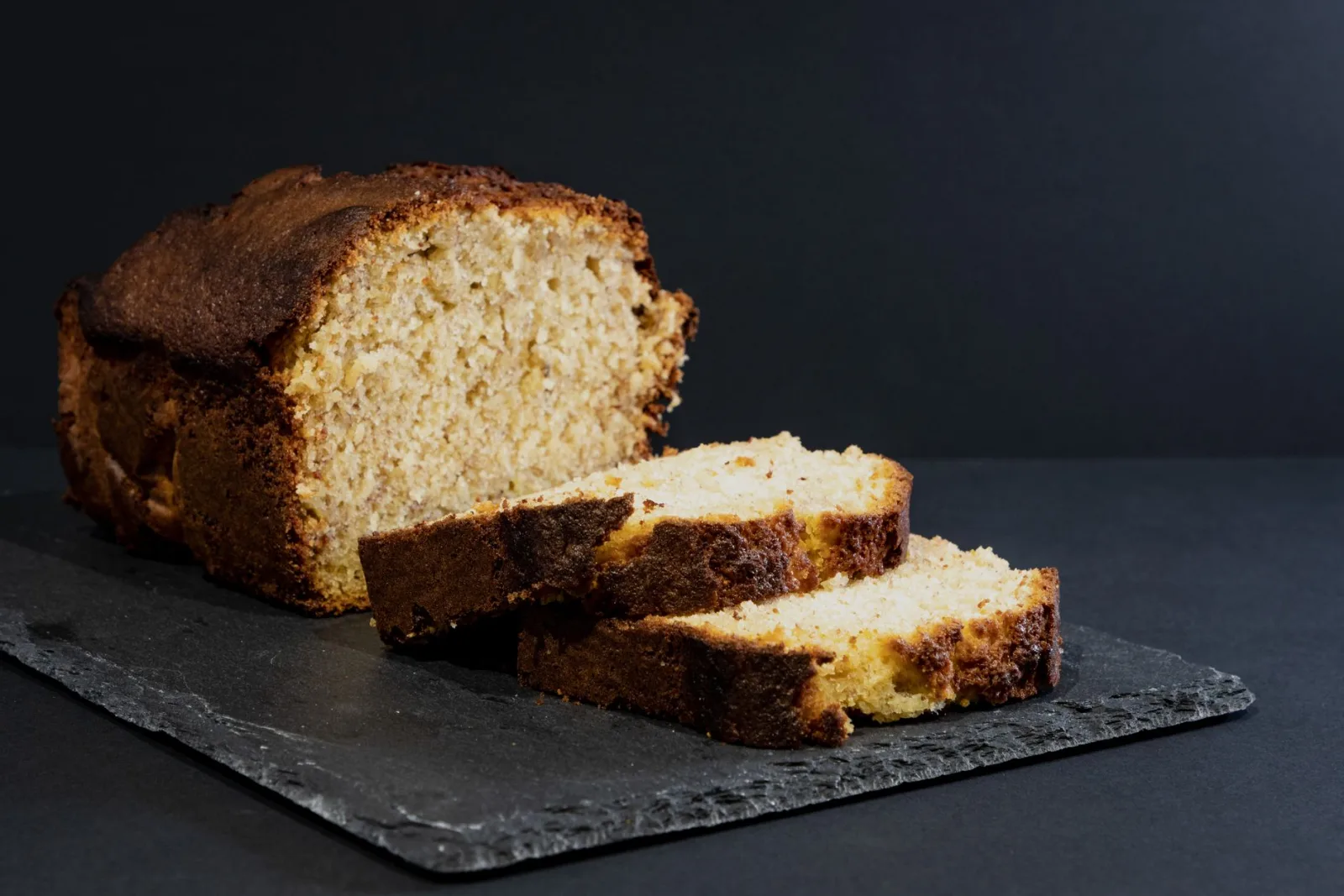
Banana bread nearly always fails the same way: a very dark crust, and a heavy, sticky centre that looks raw even after an hour in the oven. It is not a recipe problem but a dosing one: too much banana, counted rather than weighed, and baking judged by colour.
It is the cake I make most often, because it uses up the bananas my children turned their noses up at. I still ruined a good dozen before understanding that banana is a liquid ingredient.
Banana is a liquid, not a dry fruit
A very ripe banana is about 75 % water. Mashed, it behaves in a batter like thick milk. A recipe that says “3 bananas” can therefore bring 300 g or 450 g of purée depending on their size, and that gap is enough to turn a loaf from moist to gummy.
Weigh the peeled bananas. For 220 g of flour, 300 g of banana is the most the batter can take and stay light.
Ripeness matters as much as weight. As it ripens, banana turns its starch into sugars: a banana speckled with black is sweeter, more fragrant and more liquid. That is the one you want, but it means not going over the dose.
The ratios
For a 24 to 26 cm loaf tin:
- 300 g very ripe bananas, weighed without the peel
- 2 eggs
- 100 g light soft brown sugar, or white sugar
- 90 g butter, melted and cooled to lukewarm
- 220 g flour
- 1 level teaspoon bicarbonate of soda
- 1 teaspoon baking powder
- 1 pinch of salt, 1 teaspoon vanilla
The bicarbonate is not there by chance. Banana and brown sugar are slightly acidic: the bicarbonate reacts with them, raises the loaf and deepens the colour of the crumb. With white sugar the baking powder takes over, hence both.
Mixing, as little as possible
This is the second cause of a dense loaf, and the least known.
- Mash the bananas with a fork, not a blender. A blended purée becomes almost liquid and gives a tighter crumb. A few lumps left are a good thing.
- Combine the wet ingredients: bananas, eggs, sugar, melted butter, vanilla.
- Combine the dry ingredients separately: flour, bicarbonate, baking powder, salt.
- Tip the dry into the wet and fold with a spatula, fifteen to twenty strokes, until no flour is visible. No more.
An overworked batter develops the gluten in the flour: the loaf turns rubbery and fills with tunnels. Same logic as for a moist chocolate cake, where the flour decides the result far more than the chocolate does.
Baking, and how to tell it is done
170 °C, 55 to 65 minutes. That is long, and it is normal: a loaf is deep, and banana slows down the setting of the centre.
The trap is the crust. Banana sugars brown very fast: after 30 minutes the top is already dark. Lay a sheet of foil loosely over the tin halfway through and let it finish.
To tell if it is done, a knife blade is not always enough: it can come out clean after passing through a cooked area and miss a centre that is still wet. Two more reliable signs:
- the crack on top should no longer be shiny or damp at the bottom;
- the centre reaches about 95 °C on a probe thermometer.
In my oven, which runs too hot underneath, a metal tin set low gives an almost burnt base. I line the tin with baking paper and put it on a rack halfway up, with an empty tray below.
What goes wrong, and why
| Symptom | Cause | Fix |
|---|---|---|
| Gummy centre, looks raw | too much banana, or baking too short | 300 g maximum, bake to 95 °C in the centre |
| Crust almost black | banana sugars, oven too hot | foil halfway, 170 °C and no higher |
| Dense, rubbery crumb | batter overmixed | fold with a spatula, stop as soon as the flour disappears |
| Dry loaf | bananas not ripe enough, baked too long | black-speckled bananas, take out at 95 °C |
| Soapy taste | too much bicarbonate | one level teaspoon, not heaped |
Resting, after baking
Ten minutes in the tin, then turned out onto a rack. Left in the tin, it condenses its steam onto the sides, which go soft.
Above all, this loaf is better the next day. The moisture from the banana spreads overnight, the crumb firms up and the flavour develops. I wrap it in a tea towel once lukewarm, then in film the next day.
As for sugar, banana brings a lot: you can go down to 70 g without losing softness, but not below without the crumb drying faster, for the reasons explained in the sugar-free chocolate cake. And for a clean release, the reflex is the same as in the easy madeleines recipe: never let it cool in the tin.
Frequently asked questions
What is the difference between French cake à la banane and banana bread? It is the same cake under two names. English-language banana bread is often denser and raised with bicarbonate alone, while French recipes bring it closer to pound cake, with baking powder and a lighter crumb.
Why is my banana bread gummy in the middle? Too much banana for the amount of flour, or baking stopped too early because the crust looked ready. Weigh 300 g of banana for 220 g of flour, and cover with foil so baking can go on without burning the top.
Can I use bananas that are not ripe yet? You can, but the loaf will be bland and drier: the starch in a green banana has not yet turned into sugar. A yellow banana with no spots ripens in two days in a closed paper bag.
How long does it keep? Three to four days at room temperature, well wrapped. It also freezes very well, in slices separated by baking paper.